

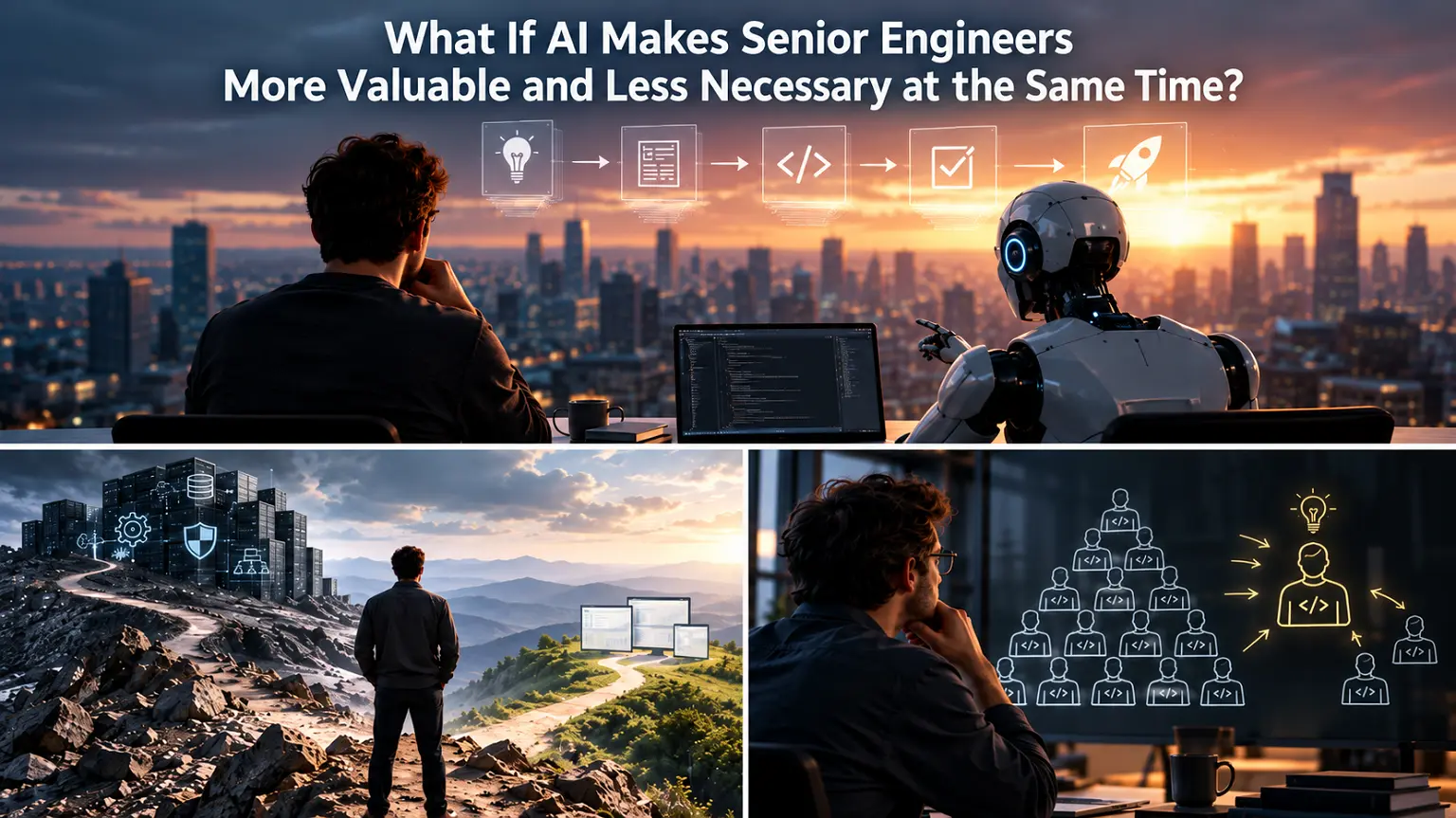
What If AI Makes Senior Engineers More Valuable and Less Necessary at the Same Time?
Most discussions about AI and software engineering revolve around the same question: Will AI replace software engineers? I think that may be the wrong question. A more useful one is this: How many hours of experienced engineering talent will each software project require in an AI-first world? Those questions sound similar, but they lead to very different conclusions. Senior engineers may remain extremely valuable because judgment, experience, and the ability to reason about complex systems are difficult to replace. Yet if a project that once required 1,000 hours of senior engineering time can eventually be built with 100 hours of senior oversight, the economics of software development change dramatically even though senior expertise itself remains essential.
The reason is not simply that AI can generate more code. The deeper shift comes from the economics of software itself. Many systems are relatively straightforward, many products have uncertain or limited lifespans, failure costs vary enormously, and much of modern software is already assembled from managed services rather than built from scratch. At the same time, AI may reduce not only implementation costs but also the cost of debugging, maintenance, and refactoring. If these trends continue, companies may increasingly use experienced engineers selectively at the points where their judgment creates the most value rather than involving them deeply in every stage of implementation.
This argument does not apply equally to all software. Safety-critical systems, financial infrastructure, security-sensitive platforms, and heavily regulated software may continue to require substantial senior engineering involvement from the beginning. The more interesting case is the much larger category of ordinary business software, internal tools, early-stage products, workflow systems, and conventional SaaS applications. In those environments, the relationship between risk, uncertainty, and engineering cost may change much faster.
Not Every Software System Justifies the Same Level of Engineering
Software engineering discussions often treat every system as though it were a distributed database, a payment network, or an operating system. In reality, much business software consists of familiar patterns such as CRUD applications, dashboards, workflow automation, authentication, permissions, reporting, forms, integrations, and conventional SaaS features. These systems still require engineering work, but they do not always require sophisticated architecture or deep computer science. Historically, even ordinary applications demanded considerable technical skill because translating requirements into working software was difficult. AI is steadily lowering that barrier by helping developers generate implementations, debug errors, write tests, understand unfamiliar code, construct APIs, and integrate external services.
This does not mean engineering expertise disappears. It means the boundary of what a less experienced developer can build independently moves outward. Work that once required constant senior support may increasingly be completed by a mid-level or junior developer working with AI, while the senior engineer becomes involved only when the problem crosses a threshold of complexity, uncertainty, or risk. That matters because labor demand depends not only on whether expertise is valuable, but also on how often it must be applied.
The Economics of Upfront Engineering Are Uneven
The value of good architecture depends partly on how long the software survives and how likely the business is to keep investing in it. Engineers naturally think about maintainability, scalability, extensibility, clean abstractions, and technical debt, but architecture has an investment horizon. A system expected to become a critical platform used by thousands of people for ten years should be engineered differently from an internal tool supporting a process that may disappear in eighteen months.
Many software products disappear for reasons that have little to do with software quality. A business may change direction, a product may fail to find customers, a startup may run out of money, a larger platform may absorb the functionality, or an acquisition may make the system irrelevant. In those cases, the software can disappear long before technical debt becomes costly. If a system dies before the benefits of sophisticated architecture are realized, some of that early engineering investment never produces a return.
This creates an important economic tension. Suppose a company is building a new product while still uncertain whether customers actually want it. The traditional engineering instinct may be to build the system properly from the beginning so that it can scale later, but that assumes there will be a meaningful "later." For many early-stage products, the largest risk is not architectural failure at scale. It is that the product never finds meaningful demand.
In that environment, speed of learning may be more valuable than architectural perfection. A rapidly built product can answer questions about customer behavior, pricing, workflows, and product-market fit. Once those uncertainties fall, the company is in a better position to decide where serious engineering investment is justified. The point is not that quality should be ignored, but that its expected return depends on whether the system survives long enough for that investment to matter.
The Cost of Failure Changes the Calculation
The argument becomes stronger when we distinguish between systems where failure is inconvenient and systems where failure is expensive or dangerous. A defect in an internal reporting dashboard may create confusion and require a few hours of repair. A similar defect in a medical system, payment platform, security product, or financial infrastructure can have far more serious consequences.
A useful mental model is to think of expected technical risk as a combination of the probability of failure and the cost of failure. When both are low, spending heavily to eliminate every possible technical problem may not be economically rational. When either is high, experienced engineering becomes much more valuable. This is why the same AI-first strategy that works well for an internal tool may be completely inappropriate for a system handling money, sensitive data, health decisions, or other high-consequence operations.
This also explains why broad claims about AI replacing senior engineers are too simplistic. The relevant question is not whether AI can generate working code. It is whether the cost of being wrong is low enough that a less experienced developer, supported by AI and occasional expert review, can reasonably own the implementation.
AI May Change the Economics of Repair
Traditional software engineering is built partly around the assumption that bad software is expensive to fix later. Historically, that has often been true. A poorly documented codebase could take an experienced engineer weeks to understand, debugging unfamiliar systems could be slow, refactoring expensive, tests missing, and migrations painful. Those realities made prevention especially valuable because correction costs could become very high.
AI may weaken that assumption by reducing not only the cost of creating software but also the cost of understanding and repairing it. Coding agents can already analyze unfamiliar code, trace dependencies, explain functions, generate tests, identify likely bugs, suggest refactors, and assist with migrations. If those capabilities improve substantially, the premium placed on preventing every possible mistake upfront may decline because some mistakes become cheaper to correct later.
However, this argument depends on an important assumption: AI must become good at maintenance, not just code generation. If AI can produce software quickly but remains unreliable at understanding complex codebases, diagnosing subtle failures, or safely refactoring systems it did not originally create, then the traditional case for maintainability upfront remains much stronger. Lighter initial engineering becomes significantly more convincing only if AI lowers the cost of future repair as well as initial construction.
Not All Technical Debt Is Equal
Technical debt can sometimes be rational, but only if we distinguish deliberate, reversible shortcuts from expensive-to-reverse mistakes. Choosing a simple architecture because the product may fail is very different from accepting weak security, corrupt data models, hidden business rules, or design decisions that make future changes nearly impossible. One type of debt can be repaid later. The other may create consequences that are difficult to unwind.
A better question than "Are we taking shortcuts?" is "How reversible are these shortcuts?" If a decision can be changed later at reasonable cost, deferring engineering investment may be rational. If it creates irreversible data problems, security exposure, compliance risk, or deep architectural lock-in, delaying expertise may be far more expensive than involving experienced engineers from the beginning.
The AI-first strategy is therefore strongest when mistakes are recoverable. A company can often tolerate an imperfect internal interface, a simple deployment model, or a codebase that needs cleanup. It may not be able to tolerate lost financial records, broken authorization boundaries, or corrupted critical data.
Senior Engineers May Become More Valuable Per Decision
This creates a paradox. Senior engineers may become more valuable at exactly the same time that each project needs fewer hours from them. Their judgment can be concentrated around a smaller number of high-leverage decisions: architecture reviews, security, data modeling, difficult debugging, reliability, performance bottlenecks, system boundaries, and major technical tradeoffs.
Meanwhile, AI-enabled developers may handle a larger share of implementation work independently. A team that once required several senior, mid-level, and junior engineers might eventually operate with fewer human developers and more AI-assisted implementation, while one experienced engineer supervises the areas where judgment matters most. The exact structure is difficult to predict, but the direction is plausible: expertise becomes less evenly distributed across the development process and more concentrated around the moments where experienced reasoning materially changes the outcome.
This means that "senior engineers becoming more valuable" and "companies needing fewer senior engineers per project" are not contradictory. The value of a skill and the quantity of that skill required are different variables. A surgeon can be extremely valuable even if a procedure requires only a few minutes of direct involvement. The same logic may increasingly apply to senior engineering.
Senior Engineering Could Become a Fractional Resource
If projects require fewer hours of senior involvement, some companies may no longer need a senior engineer embedded full-time in every team. They may need experienced engineers for a few days of architecture work, a security review before launch, help during a difficult production incident, and another review when the system reaches a new level of scale. Senior engineering could begin to resemble other forms of specialized expertise that organizations consume selectively rather than continuously.
The economic implication is significant because one specialist can potentially support multiple teams or projects. A senior engineer may remain highly compensated while each project consumes only a fraction of that person's time. Their importance does not disappear. It becomes more concentrated, shifting from continuous production toward high-leverage intervention.
Successful Software Creates the Hardest Counterargument
There is a major weakness in this strategy: software often survives longer than expected when it succeeds. A temporary MVP can become the core system of a company, an internal tool built in weeks can accumulate thousands of users, and a small SaaS application can grow far beyond its original assumptions. The systems that survive are also the ones most likely to expose shortcuts that were acceptable when they were small and uncertain.
This is the strongest argument against underinvesting in engineering too early. If a system unexpectedly becomes critical, deferred architectural decisions can become expensive and technical debt can constrain the business. The answer, however, is not necessarily to engineer every early-stage system for ten years of growth. A more flexible principle is to increase engineering investment as uncertainty decreases, usage grows, and the cost of failure rises.
Early in a product's life, business uncertainty may dominate. Later, once the product has proven that it will survive, technical risk becomes more important. Engineering strategy should evolve with the product rather than assuming the same level of rigor is economically optimal from day one.
Senior Expertise, Senior Hours, and Senior Headcount Are Different Questions
This distinction is crucial when discussing the labor market. There are really three questions: Does senior engineering expertise remain valuable? How many senior-engineer hours does each project require? And how many senior engineers does the economy employ overall? These questions are related, but they are not the same.
AI could leave the first answer unchanged or even strengthen it. Senior judgment may remain extremely valuable while the second number falls sharply because developers and AI agents handle more implementation independently. But that still does not tell us what happens to total employment, because the third question depends on how many software projects exist.
If software becomes dramatically cheaper to build, companies may decide to build much more of it. Projects that were previously uneconomical may become viable, businesses may create internal tools they would never have funded before, and individuals may build applications that once required entire teams. Two forces therefore move in opposite directions: fewer human engineering hours may be needed per project, while the total number of software projects may rise substantially. The long-term effect on senior engineering headcount depends on which force grows faster.
That is why saying "AI may reduce senior-engineer hours per product" is much stronger than saying "AI will reduce the number of senior engineers." The first follows from the economics described here. The second depends on how demand responds to cheaper software.
The Causal Chain Is More Important Than the Headline
The argument is better understood as a sequence than as a prediction. AI lowers implementation costs, allowing less experienced developers to produce more independently. Many software systems are simple enough, short-lived enough, uncertain enough, or low-risk enough that heavy upfront engineering is not always justified. If AI also lowers future maintenance and repair costs, deferring some engineering investment becomes more rational. Experienced engineers can then be concentrated around the smaller number of decisions where complexity, irreversibility, or failure costs are high.
That leads to the central conclusion: senior expertise may remain scarce and highly valuable while the number of senior-engineer hours required per product declines. The disruption, in that case, does not come primarily from AI replacing senior engineers directly. It comes from changing how much of their time each product consumes.
The Bigger Shift
The future of software engineering may therefore be less about maximizing engineering quality from day one and more about matching engineering intensity to uncertainty, reversibility, system lifespan, and the cost of failure. Low-risk and uncertain products can begin with lighter engineering investment, while systems that prove their value, accumulate users, or become more consequential can receive increasingly serious technical attention.
That principle avoids both extremes. It does not imply that senior engineers are becoming obsolete, but it does challenge the assumption that every project needs the same level of senior involvement throughout its lifecycle. If AI continues to lower both implementation and repair costs, the most important change may be that senior engineering becomes a more concentrated resource, applied where its expected value is highest.
#ArtificialIntelligence #SoftwareEngineering #AI #FutureOfWork
Leave a Reply
Your e-mail address will not be published. Required fields are marked *